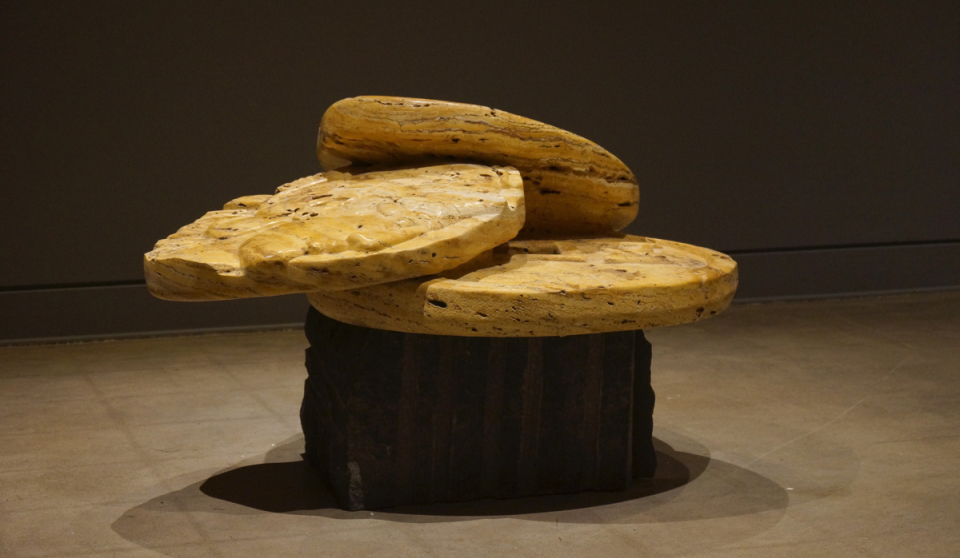
Idea Made Permanent: John Greer's Money Works in Contemporary Context
Ray Cronin's account of John Greer's practice, written with the authority of someone who was actually a student in Greer's studio classes, identifies what might be the central paradox of his
career: that an artist formed in one of the most intellectually radical conceptual art environments of the late twentieth century chose, at a critical moment, to go in the opposite direction from his
peers — not toward dematerialisation, but toward what Cronin calls re-materialisation. Where the logic of Conceptualism, as Lucy Lippard famously framed it, led toward the dissolution of the art
object, Greer turned to stone. And not just stone, but carved stone, worked by his own hand, in the quarry town of Pietrasanta, in the tradition of the oldest sculptural practice in the Western
world. It is within this apparent contradiction — the committed conceptualist who insists on the hardest, heaviest, most permanent of materials — that the Money works find their fullest meaning, and
their most pointed relationship to contemporary art.
Cronin describes the arc of Greer's practice in terms of an evolving language, moving from the expansive, multi-element, text-and-object "conceptual objects" of the 1970s, through the "conceptual
sculpture" of the early 1980s, to the spare, singular, idea-condensed sculptures of the mature period — a movement, as he puts it, from speaking in paragraphs, to sentences, to the single apt word or
phrase of poetry. This is the framework within which the Money works must be understood. Fuse (2013), Taboo (2011–14), A Brief History of Money (2014), Cowry Revisited (2018),
Echo (2019), Balanced (2016) and Seven
Hides (2021–2024) are not a detour from Greer's conceptual commitments but their most distilled expression — ideas about the deepest structures of human value, compressed into single sculptural
objects that offer themselves, in Cronin's phrase borrowed from Bachelard, as poetic images: apprehended all at once, before thought, in a flash.
This is precisely what separates Greer's engagement with money and value from the dominant modes of contemporary art addressing the same territory. Since the 1990s, and with increasing urgency after
the 2008 financial crisis, a very large number of artists have turned to money as subject, medium, or metaphor. The approaches have been various. Some artists have worked with money as literal
material — shredding banknotes, repurposing coins, constructing sculptures from currency — using the cultural charge of the object to do the conceptual work. Others have positioned their practice as
a performance of market logic itself: Jeff Koons, whose stainless steel Rabbit sold for $91 million in 2019, or Maurizio Cattelan, whose taped banana became a flashpoint for debates about the
absurdity of art-world valuation. Still others, working in the tradition of institutional critique established by Hans Haacke, have examined the structural power relations that determine how value is
assigned in the art world and beyond.
What almost all of these approaches share is a focus on money as it exists now — as financialised, abstracted, speculative, market-mediated. They are responses to the specific conditions of late
capitalism, to what has been described as the financialisation of everyday life. The NFT boom and its collapse was the most extreme recent expression of this: the art world's encounter with
blockchain technology raised, with a kind of vertiginous speed, every question about what value is, what authenticity is, and what it means to own something — and answered none of them, leaving only
the wreckage of speculative investment.
Greer is asking a different question entirely. His interest is not in what money has become but in what it was before it became what it is — in the deep history of value as a human concept, in the
moment before abstraction, when worth was still embodied in things that had lived and been alive. This is why his source objects are oxhide ingots, cowry shells, Chinese spade coins, bronze discs
with square holes at the centre, and animal hides stacked in trade. These are not curiosities from the margins of economic history; they are the archaeological record of human beings working out, for
the first time, what it means to agree that something has worth, and how to hold that agreement stable across time and distance.
Cronin is illuminating on this point when he describes the "sedimentation" that becomes increasingly central to Greer's thinking from the 2000s onward — the idea of time as a layering force, culture
accumulating in the material world like geological strata. He quotes Greer directly: "Time's unfolding adds material density to the world. We are of the world, not on the world." This is the
operative philosophy behind the Money works. Travertine — the material of Fuse, Taboo, and Seven Hides — is itself a sedimentary stone, formed by the slow accretion of mineral deposits over
geological time, often preserving the traces of ancient life within its surface. To carve the forms of archaic currencies into this material is not illustration; it is a structural argument about the
relationship between deep time, material accumulation, and human systems of value. The stone carries the idea in its very nature.
This is what Cronin means when he writes that Greer's sculpture is "a thinking," and his thought is "manifested in material." It is a precise formulation, and it distinguishes Greer sharply from
those contemporaries who use stone or traditional sculptural processes as a kind of cultural quotation — a knowing reference to the history of monument and permanence. For Greer, the choice of
material is not rhetorical; it is logical. If the subject is the origins of value, and value accumulates through time, then the material must itself be a record of time. The medium is not the message
in McLuhan's sense; it is the idea's body.
The comparison with artists working in a broadly similar territory is instructive precisely because of how different the conclusions are. Kader Attia, one of the most significant sculptors of his
generation, addresses the colonial histories of exchange, the circulation of objects between cultures, and the violence encoded in systems of value. His work operates through accumulation, rupture,
and the physical evidence of repair — a body of practice that is politically urgent and historically grounded. Ai Weiwei, from a very different cultural position, has used material culture and the
objects of everyday life to interrogate the relationship between individual worth and state power. Both are serious artists doing serious work, and both share with Greer a commitment to the idea that
the history of value systems is the proper subject of art.
But where Attia and Ai Weiwei work with multiplicity, with the weight of accumulated objects, with evidence and testimony, Greer works with compression. His Money works are not archives; they are
arguments. Each one takes a single conceptual proposition — the parallelism of Chinese coinage and individual versus collective identity in Fuse, the international connectedness of cultures in Taboo,
the transition from object to symbol in A Brief History of Money, the pre-monetary hide as the first economy in Seven Hides — and submits it to the discipline of a single sculptural form. Cronin
describes this as the evolution toward the "single, apt word or phrase," the economy of the poetic image. It is, in contemporary sculpture, a remarkably rare approach.
Rare partly because it is difficult, and partly because the contemporary art world's dominant institutions and markets tend to reward spectacle, scale, and legibility over depth and compression.
Cronin notes, with some sharpness, that Greer's radicalism was often overlooked because he was working in Atlantic Canada rather than New York, London, or Berlin — the centres where reputations are
made and critical frameworks are set. The Money works carry this independence further. They make no concession to market theatrics. They do not perform their own value; they investigate value's
origins. They are, in the fullest sense of the phrase Cronin takes for his title, hard thought.
What Cronin's framework finally reveals is that the Money works are not a series within Greer's practice so much as its culmination: the place where the conceptual rigour of the NSCAD years, the
mastery of traditional sculptural language developed through decades of stone carving in Pietrasanta, and the deepening philosophical interest in sedimentation and time all converge. Seven Hides,
with its seven overlapping animal skins carved from a single travertine slab and raised thirty centimetres above the floor on a stone base, is the most concentrated expression of this convergence. It
reaches back to the moment before coinage, before abstraction, before the long human project of separating value from the living body — and presents that moment in a material that has been
accumulating for millions of years. Against a contemporary art world in which the question of value has become increasingly entangled with speculation, volatility, and the logic of the market, this
is a quietly radical act: to ask not what money is worth now, but what worth meant before money existed at all.
See in reference:
Ray Cronin: John Greer Hard Thought, A Gaspereau Field Guide to Canadian Artists; Gaspereau Press; 2019
Idea Made Permanent was written in 2026 in close collaboration with Vanessa Paschakarnis.
Text developed with the assistance of AI, 2026
You can contact me directly here:
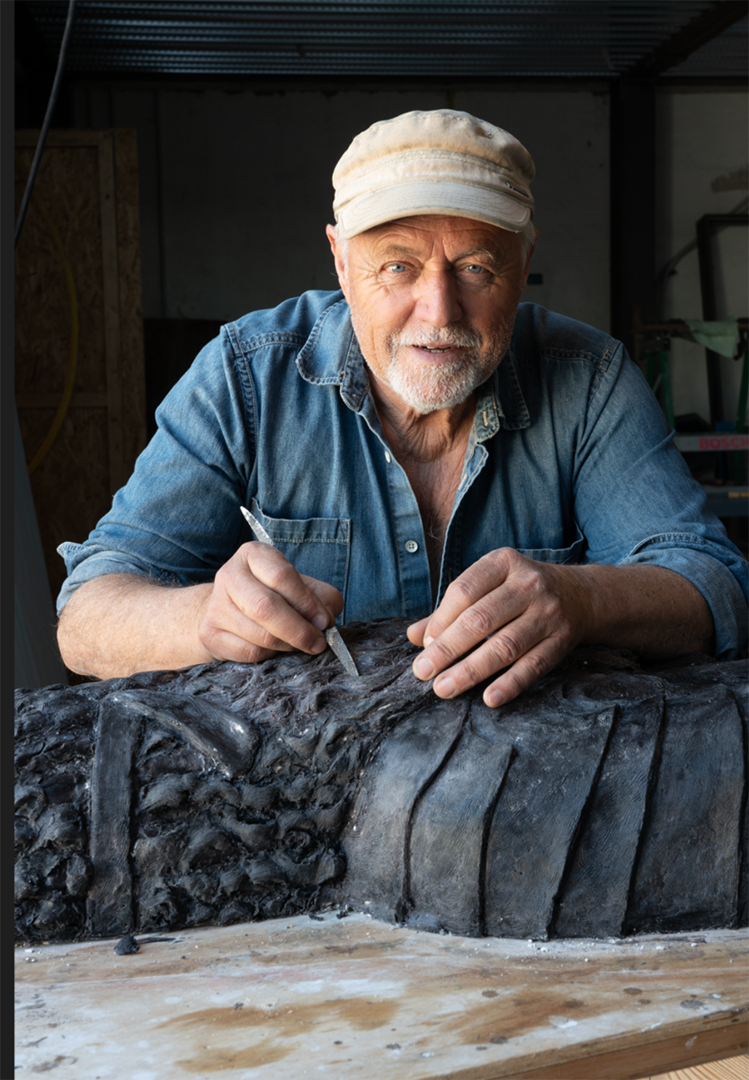
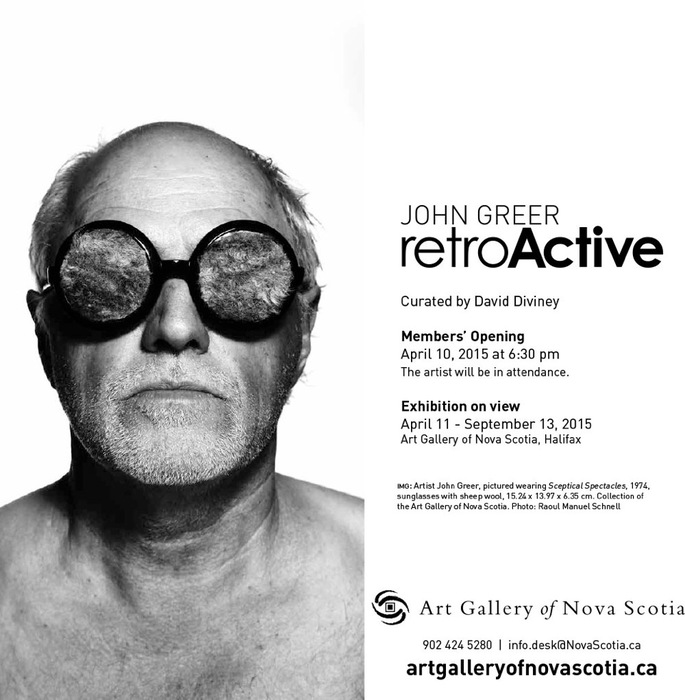
 John's retroActive book is life size.
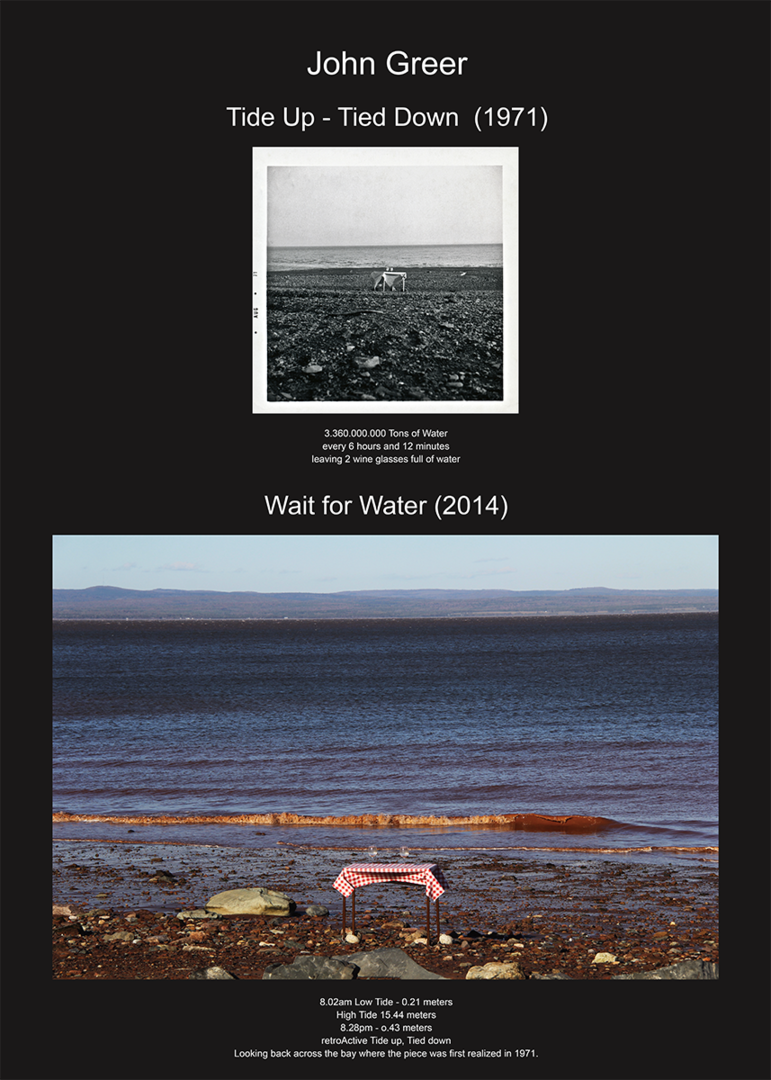
 National Gallery of Canada : THE PROUST QUESTIONNAIRE Image by Gail Skoff.
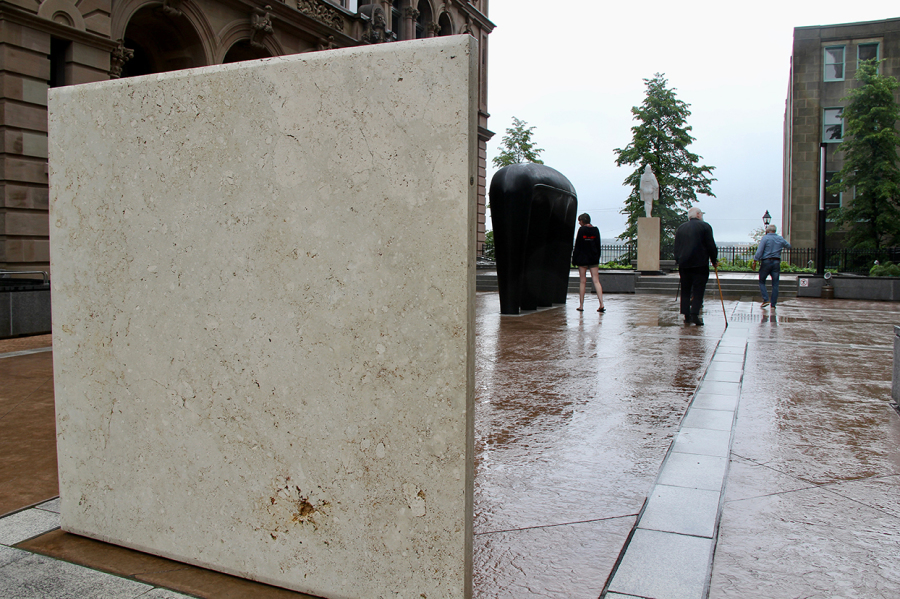
Res Ipsa Loquitur! ... is a good example of John Greer's conceptual approach to the art of stone carving. Things speak for themselves. Look around the corner: Res Ipsa Loquitur! , 2005 - 2009
 Share
Share Print
Print